
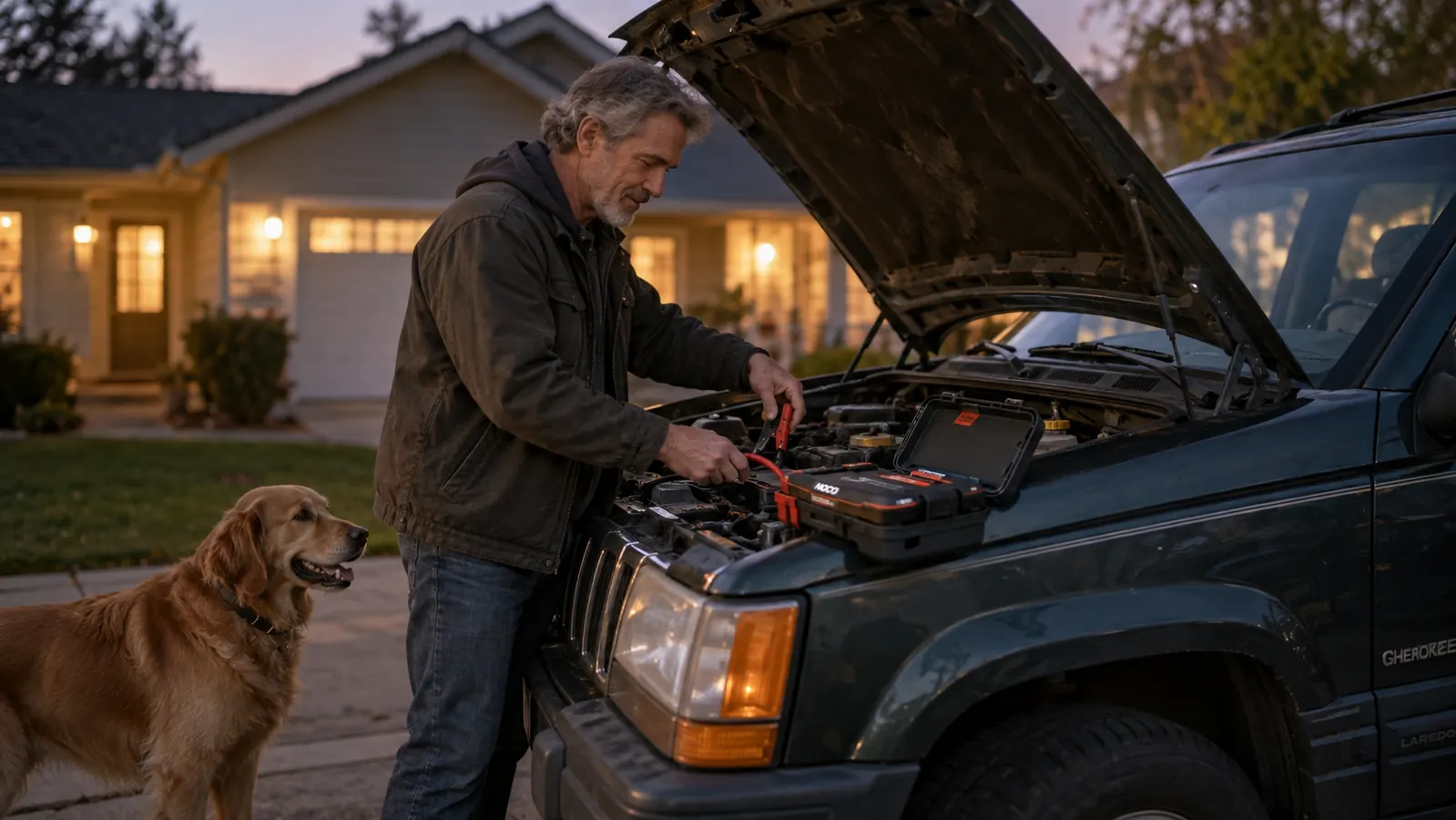
My Highlander's battery died on a Tuesday morning last January in my own driveway. No slow cranking the night before, no dim headlights to warn me. I turned the key and got silence, with a customer meeting in Springfield an hour away. I did what I have done for thirty years of driving. I grabbed the jumper cables from the trunk and went looking for a neighbor with a running car.
That was the moment I finally admitted that cables only work when someone else is around. Last winter, twice, no one was. The NOCO Boost GB40 I had been reading about for months does not need a second car, and after using it on a cold parking lot in March I stopped kidding myself about which one belongs in my trunk.
That is the short answer to the question in the title. If you drive alone, carry the NOCO. If you want the honest full picture, including the three ways plain cables still beat it, keep reading. I will give you the row by row comparison first, then tell you exactly who should buy which, because I think the right answer for some of you really is the cheap coil of copper.
Here is the comparison in a form I can actually use, row by row, with the winner marked honestly. Where the cables win, I say so.
| NOCO Boost GB40 | Jumper Cables | |
|---|---|---|
| Gets you moving with no second car | Works alone in an empty parking lot at any hour | Needs a second running vehicle and a volunteer driver |
| What you carry | One case, roughly two and a half pounds | About one pound of cable |
| Time from open hood to running engine | About two minutes with nobody helping you | Depends on finding a helper, often an hour or more |
| Safety if you hook it up wrong | Spark-proof clamps and reverse-polarity protection | The only protection is your own care |
| After a year in the trunk | Holds its charge about a year; recharge it every few months to be safe | Still ready, no charging ever required |
| Other uses | USB port charges a phone or tablet | None at all |
| Cost to get started | Costs more once, still far less than one tow | A few dollars and done |
| Best for | Drivers who travel alone or in rural areas | Households with a second car and a willing driver |
Where the NOCO Wins
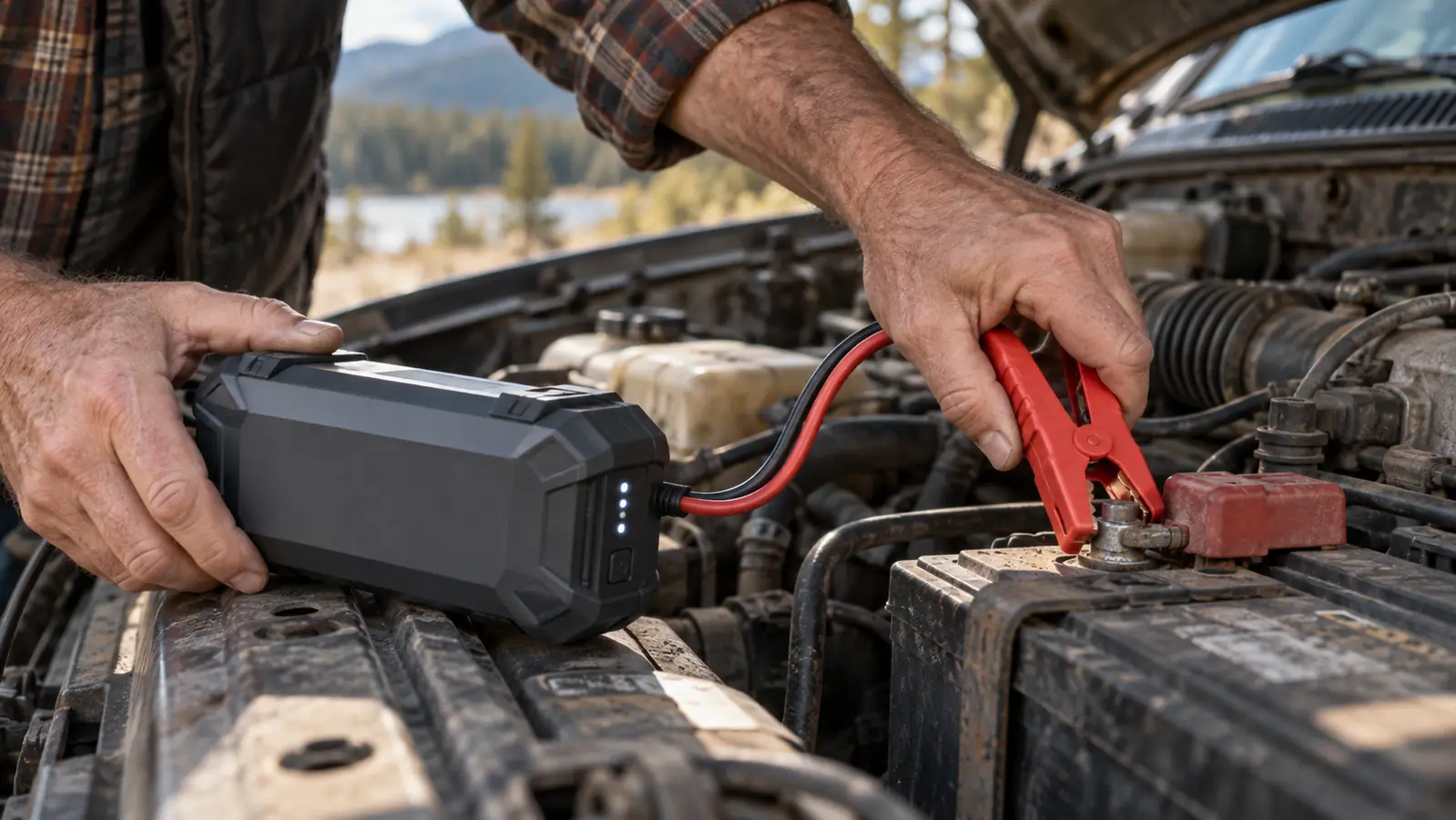
The first and biggest win is independence, and it is the whole reason this comparison exists. I ordered the GB40 in February, a month after my driveway dead battery, and I did not have to wait long to put it to work. My regular route runs about seventy miles up US-65, and most of it has nothing between exits but farmland. Last March, on an overnight trip, my battery died at a gas station where I was the only customer. I opened the NOCO case, clamped it to the battery, waited the minute the instructions ask for, and the engine fired. No second vehicle. No waving down a stranger. No waiting for a tow truck that would have cost more than the unit.
The second win is the one I did not expect to care about: safety on a modern car. My Highlander is eleven years old, but it still has a computer that manages everything, and a wrong connection with plain cables can send a spike through that computer. The Boost has spark-proof clamps and reverse-polarity protection. If I clamp it backward, it refuses to do anything, which is exactly what I want from a device I am using in the dark at six in the morning.
Third, it earns its spot even when nothing is dead. The GB40 has a USB port, and I have topped off my phone at rest areas when the car charger was not doing the job. That sounds small until you are three hours from home on a two-lane with a phone at four percent. The unit will also start engines a good deal larger than the one in my Highlander, which means it is not just my emergency tool. It is my hello to a stranger in a parking lot who is about to be late for something.
Where Jumper Cables Win
Now I will give the other side its due, because the cheap coil of copper is not a bad answer for everyone. Cables weigh about a pound and fold flat, where the GB40 is heavier and needs a case. Cables never need a charge; a set that has sat under the back seat since 2016 is still ready the day you finally need it. And cables cost a few dollars, a fraction of what the NOCO goes for today. If you have two cars and a driveway where you can park them nose to nose, that fraction matters.
There is one more win that is easy to miss until you live it. The GB40 is a smart device, and smart devices have a floor. If a battery is so far gone that it reads almost no voltage, the Boost will not try to jump it, because it needs a little power just to wake up its own safety circuits. Wire does not read voltage. Plain cables will carry current from a running donor car straight into a completely flat battery, and usually that battery will come back. In that one scenario the oldest technology in this article is the most dependable.
Let me be direct about who I think should pick cables. If your car mostly sits in a garage at home, if a second vehicle is parked next to it most nights, if you never drive anywhere remote, buy the good cables and skip the gadget. I also think every household should own a set of cables anyway, even the ones that buy the NOCO. They are cheap, they do not expire, and there is no such thing as too many ways to get a car started.
Last March, at a gas station off US-65, I was the only car at the pumps and my battery was stone dead. Jumper cables would have been a coil of copper in my trunk. The NOCO had me moving in under five minutes.
Why It Took Me Thirty Years to Carry a Jump Starter
Cables have been standard equipment in my cars since I was nineteen, and they never once failed me. That statement is true and it is also misleading, because the cables never had to do anything. They sat in the trunk through three vehicles. On the rare days I actually needed a jump, a second car was always close enough to matter. I told myself that was good planning. It was geography. I parked where other people parked.
That changed when my territory shifted and I started spending nights away from home on a regular basis. My old rule had always been to break down where people are, and suddenly I could not control that anymore. The morning my own driveway gave me silence, with the hood up and no second car anywhere, I finally understood that jumper cables are a social tool. They need a friend. A jump starter only needs you.
So I do not regret the thirty years, and I still keep cables in the car as a backup because they cost nothing and never expire. But I ordered the NOCO the week after that driveway morning, and the first time it started my car in an empty lot, I stopped thinking of it as a gadget and started thinking of it as a spare part. That is the shift this whole comparison is really about.

How I Actually Tested Both
I am not a mechanic, and I did not run a controlled test with timers and clipboards. I used both tools the way a normal person would and I kept notes. For the cables, that meant a friend pulling his truck nose to nose with my Highlander in a parking lot, clamps connected, donor engine running for a few minutes, then my engine catching. It worked exactly the way cables have always worked. It also took two people, two vehicles, and about fifteen minutes from the first can you give me a jump to driving away.
For the NOCO the test showed up on its own one March morning at a gas station off US-65. From the moment I unzipped the case to the moment the engine caught was less than four minutes, with me as the only car at the pumps and a light rain starting. No second vehicle. No phone calls. No waiting.
My notes from those two mornings match the table above almost perfectly. Cables are lighter, cheaper, and they do not need to be charged, and they will wake a battery that is completely flat. The NOCO starts the car faster, works when I am alone, will not let me hook it up wrong, and charges my phone. If you only buy one, buy the one that works when you are alone. That is the honest conclusion from my two tests.
Cold Weather, Hot Weather, and Where I Store It
Missouri gives a car both extremes, so storage is not a small question. A lithium pack is happier at room temperature than it is baking in a parking lot for a week, and I do not leave the NOCO in the car through the worst of July. I keep it in a padded case in the cabin, where I can see it. Seeing it is what reminds me to charge it, which brings me to the second habit.
The habit that keeps me honest is a reminder on my phone for the first of every other month. The GB40 holds its charge for months, so this is not a chore; it is an hour on the wall charger while I am doing paperwork. A jump starter that goes dead quietly is just another dead battery, and the whole point of the tool is to break that cycle.
Cold weather is where the amperage rating earns its keep. The GB40 is rated for gas engines up to six liters, well beyond the engine in my Highlander, and enough to help a stranger's pickup. The coldest morning I have used it was around eighteen degrees, after the car had sat outside all night, and it did not hesitate. It also held its charge through the whole winter between top-offs. Your mileage will vary, but mine has been good.
The Verdict Is Simple: Don't Wait for a Cold Morning
Every dead battery I have dealt with recently happened when no second car was anywhere close. That is why the NOCO Boost GB40 rides in my Highlander now, and why I would buy it again. Check today's price on Amazon, and decide before you need it, not while you are standing in a parking lot at dawn.
Amazon Check Today's Price on Amazon →Who Should Buy Which
Buy the NOCO Boost GB40 if you drive alone even part of the time, if your work or your habits put you on the road before sunrise, if you take trips where a dead battery would mean a long wait, or if you simply do not want to depend on strangers. That is me, and it is probably you if the phrase sales territory means something in your life. I bought mine after one useless morning in my driveway and I have never regretted it.
Buy cables instead if you want the lowest possible cost, if your car lives in a garage next to a second car, or if you rarely drive out of town. I will also say this plainly: buy cables even if you buy the NOCO. A set of cables takes up almost no room, never wears out, and covers the one scenario where a smart jump starter refuses to work. My own setup these days is the NOCO in a small case behind the driver's seat and a set of cables in the tool bag in the spare-tire well. I treat them as different tools for different days, because they are.
Here is the honest bottom line after a year of carrying one and remembering the other. Jumper cables have rescued two-car households for a hundred years and they will keep doing it. But a portable jump starter rescues the driver who is alone, and that driver is the one I am every Tuesday on US-65. If you see yourself in that sentence, the GB40 is worth your attention.
Stop Depending on Luck With a Dead Battery
Here is where I landed after a year with both tools in the car. The cables stay, because they are cheap, they never need a charge, and they cover the one battery the smart unit will not touch. The NOCO Boost GB40 is the tool I actually reach for, because most mornings I am alone. See today's price on Amazon and decide before the next cold one catches you off guard.
Amazon Check Today's Price on Amazon →